
If you read our intro to crypto-backed loans and want to understand the actual mechanics, what happens at each stage, what you need to do, and what to watch out for, this is the guide for you.
In this article:
- Before you apply — what to have ready
- The application process — what platforms ask for and why
- How collateral deposit works — and what happens to your crypto
- How funds are disbursed — and where they land
- Managing your loan — LTV, margin calls, and repayments
- Closing the loan — how and when you get your crypto back
- How the process differs by loan type
Before You Apply
Three things to sort before you open an application:
1. Know your collateral
Different platforms accept different assets. BTC and ETH are universally supported. Stablecoins (USDC, EURC), SOL, and XRP are accepted on specific products. Check what's accepted before you start.
2. Know how much you need
Your loan amount is determined by your LTV ratio — the percentage of your collateral's value you can borrow. For example, at 50% LTV, €10,000 in BTC gives you up to €5,000. Some platforms let you borrow up to 97% of your balance, though many have lower LTV limits depending on the asset. On Nebeus, LTVs range from 50% on the Flexible Loan up to 95% on the StableLoan.
3. Understand your repayment structure
Not all loan types work the same way. Some require monthly interest and principal payments. Others are interest-only. Some require a single payment at maturity. Know which structure you're applying for before you commit.
Step 1: Create an Account and Complete KYC
A lender verifies that you are exactly who you say you are. This is done to prevent illegal activities like money laundering and is a compliance requirement for all legitimate lenders. The process is simple: you provide a valid photo ID.
On most CeFi platforms, including Nebeus, this takes a few minutes. You'll need a valid government-issued ID and, depending on the platform, proof of address.
Step 2: Choose Your Loan Type
This is the most consequential decision in the process. Each loan type is built for a different situation:
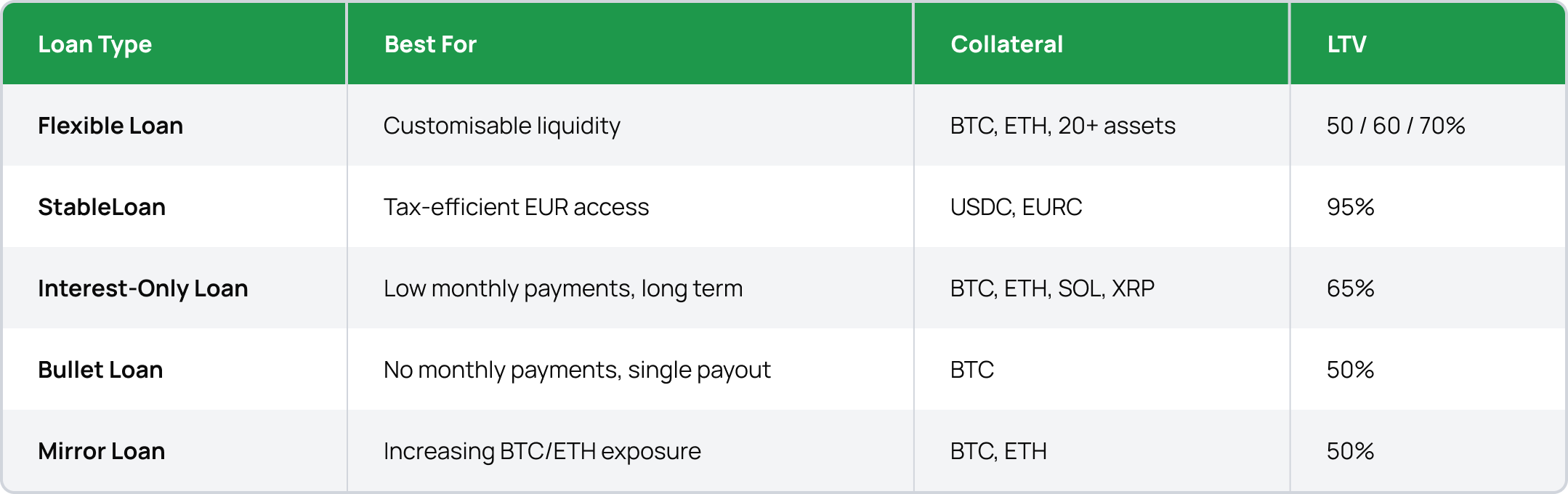
Not sure which fits your situation? Read: Types of Crypto Loans Explained
Step 3: Deposit Your Collateral
Once you've selected a loan type and agreed to the terms, you transfer your crypto to a designated custody wallet held by the platform.
Your crypto isn't sold. It's locked for the duration of the loan. While locked, you still benefit if the asset price rises.
On Nebeus, assets are held in custody with BitGo — institutional-grade cold storage used across the industry. Your collateral stays yours; it simply can't be moved until the loan is repaid.
One important note on the Mirror Loan specifically: it works differently from the others. When you deposit BTC or ETH, Nebeus uses the loan proceeds to purchase the same asset and locks both together as combined collateral. No funds are disbursed to your wallet. The Mirror Loan is an exposure strategy, not a liquidity product. If you need cash in hand, this is not the product for you.
Step 4: Receive Your Funds
For all other loan types, once collateral is confirmed, funds are disbursed to your Nebeus wallet — typically in EUR or USDC depending on the product. Once your lender confirms collateral on-chain, they'll disburse your funds to your account or wallet.
From your Nebeus wallet, EU users can transfer funds to their IBAN account in seconds, making it straightforward to use for everyday expenses, transfers, or larger payments.
All loan disbursements are sent to the Nebeus wallet and EU users have the option to then send their euros to their personal IBAN.
Step 5: Manage Your Loan
This is the stage most borrowers underestimate. Getting the loan is the easy part — managing it responsibly is what protects your collateral.
Watch your LTV. If the value of your collateral drops, your LTV rises. Each loan has a margin call threshold and a liquidation threshold. Breaching the margin call threshold triggers a notification to add collateral or repay part of the loan. Breaching the liquidation threshold means the platform will sell part of your collateral automatically. Nebeus offers the liquidation risk chart in the loan so you have everything clear from the start.
Make your repayments on time. Depending on your loan type:
- Flexible Loan: monthly interest + principal
- Interest-Only Loan: monthly interest only; principal at maturity
- Bullet Loan: no payments until maturity, then full repayment of interest + principal
- StableLoan: monthly interest; principal at maturity
Optional: automatic margin call management. On Nebeus, you can enable automatic margin call management for a 2% fee. This handles collateral top-ups on your behalf if the margin call LTV is approached.
Step 6: Repay and Reclaim Your Collateral
Once the loan is fully repaid — interest and principal — your collateral is released and returned to your Nebeus wallet. After repaying the loan, the user gets the collateral back, even if it has increased in value. Oftentimes, holding long-term is more beneficial since the collateral appreciates and you can get liquidity with a small monthly fee.
A few things to check before you reach maturity:
- Early repayment: Available on the Flexible Loan (2.5% fee for loans under €75,000). Not available on the Bullet, Interest-Only, or Mirror Loan.
- Origination fee: 2% is deducted from the first disbursement on all Nebeus loan products — factor this into your cost calculation upfront.
- Liquidation fee: If your collateral is liquidated before maturity, a 4.5% fee applies. This is standard practice across most CeFi lending platforms.
How the Process Differs by Platform
The broad process above applies across most CeFi lending platforms. Where they differ is in the details that actually matter:
Interest rates. Rates vary significantly. For leveraged BTC/ETH exposure products, Ledn charges 14% annually. Nexo starts from 2.9% depending on loyalty tier and collateral ratio — but that rate is contingent on holding Nexo tokens. Nebeus offers the Mirror Loan at 9.5%, with no token requirement.
Custody standards. Not all platforms handle custody the same way. Look for platforms that use regulated, institutional-grade custody — BitGo cold storage is an industry benchmark used by both Nebeus and Ledn.
Regulatory standing. Following the collapse of Celsius, BlockFi, and Genesis between 2022 and 2023, platform credibility became a real consideration. Nebeus is registered with the Bank of Spain for digital asset custody and exchange services — an important signal for European users who want regulatory alignment alongside their loan product.
Disbursement speed. Most CeFi platforms disburse within 24 hours of collateral confirmation. Nebeus disburses to your wallet as soon as collateral is verified, with IBAN transfers available in seconds for EU users.
Ready to apply? Start your Nebeus loan here
Next in the series: Crypto Loans vs. Selling: Which Is Right for You?
Disclaimer: This article is for informational and educational purposes only. It does not constitute financial, investment, or tax advice, nor an offer or recommendation of any product. Always consult a qualified financial or tax professional before making decisions involving financial products or crypto assets. Product terms and availability may vary depending on your country of residence and regulatory status.